Global, September 1770 · Space weather
The missing half of the 1770 superstorm
In September 1770, blood-red auroras burned over Japan, China, and Captain Cook’s ship off Timor for nine nights—an extreme solar storm now used to stress-test modern power grids. Searching 18th-century European academy journals, observatory logs, and newspapers recovers eight overlooked sightings, finds a date error still live in NASA’s historical catalog, and uses a single star in southern France to explain why Europe saw a far weaker sky.
1770 and the modern power grid
When most people hear “extreme solar storm,” they think of the Carrington Event of September 1859, when a giant eruption on the Sun set telegraph offices on fire and lit up skies as far south as Cuba and Hawaii. For modern electrical engineers, a Carrington-class storm is already a nightmare scenario: rapidly shifting magnetic currents in Earth’s upper atmosphere can induce surges strong enough to damage high-voltage transformers and knock out regional power grids.
Over the past decade, however, space-weather historians led by Hisashi Hayakawa have pointed to an even more unsettling benchmark: September 10–19, 1770. Using 110 Chinese and Japanese chronicles alongside the ship’s logs of Captain James Cook’s HMS Endeavour off Timor, they reconstructed a barrage of solar eruptions that kept blood-red auroras burning near the tropics for nine consecutive nights—far longer than the two-day Carrington storm. Because a multi-day storm pounds electrical infrastructure repeatedly without giving grids time to recover, the September 1770 “nine-night storm” is now used as an extreme worst-case stress test.1
Yet a glaring puzzle sat right in the middle of the map. East Asia was saturated with eyewitness accounts—and HMS Endeavour saw red southern lights on the same night, the earliest known case of both hemispheres at once—while Europe and the Americas looked strangely quiet. A February 2026 review noted that European reports remained “sparse and geographically confined, primarily to Germany and France,” relying on a handful of 19th-century catalog lines in NASA’s Space Physics Data Facility (SPDF). Had Europe simply been cloudy, had historians missed the sources, or did the storm itself behave very differently on the other side of the world?
What the archives turned up
Sweeping 18th-century academy transactions, observatory weather registers, newspapers, and travel narratives across ten countries changed the picture of the storm’s Western half in four concrete ways:
- Eight overlooked European and Scandinavian sightings. Four Swedish sightings from Robert Rubenson’s 1879 national catalog (Norrbärke on the night of Sept 10–11, Brunflo on Sept 19, and Lund and Stockholm on Sept 20), three Norwegian sightings from Johan Daniel Berlin’s daily Trondhjem register (Sept 11, 17, and 18), and a detailed Southern French account by Aimé-Henri Paulian at Nîmes (Sept 17) never made it into Hermann Fritz’s 1873 global list, NASA SPDF’s European table, or modern 1770 storm reconstructions.2
- A date error still live in NASA’s New England aurora database. NASA SPDF’s New England catalog (
ane720t.txt) lists Harvard astronomer John Winthrop seeing an aurora in Cambridge, Massachusetts on September 16, 1770—the exact night Cook’s crew saw the southern lights off Timor. Checking Joseph Lovering’s original 1867 transcription of Winthrop’s manuscript journal shows the real date was September 10. Lovering misprinted 10 as 16 in his 1868 summary table, and NASA’s digital file copied the phantom sighting onto the storm’s biggest night. - A compass reading in France, timed against Beijing. On September 17 in Montmorency (just north of Paris), Father Louis Cotte recorded his compass needle swinging 15 to 20 arcminutes from moment to moment during daylight—enough for him to predict that evening’s aurora before sunset. In his 1774 appendix, Cotte explicitly tied those daytime swings to Father Joseph-Marie Amiot’s sighting in Beijing from 9 PM to 3 AM local time (~13:15–19:15 UTC).
- Clear nights with no aurora, which show the storm did not reach everywhere every night. Daily weather tables from Denainvilliers in north-central France and from London show clear skies on September 14, 15, 16, and 18 with no aurora reported, even as East Asia and Timor blazed on Sept 16 and Trondhjem, far to the north in Norway, lit up on Sept 18. (One caution: Duhamel at Denainvilliers also logged nothing on Sept 17, when an aurora was seen near Paris.)
A storm in three waves
Once the newly recovered Norwegian, Swedish, and French entries are placed beside the clear-sky and overcast weather diaries, the apparent contradiction between East Asia and Europe snaps into focus. Rather than nine nights of equally intense aurora across the whole planet, the Western record shows three distinct waves:
Wave 1 (Sept 9–11): An early aurora reached Berlin (Sept 9), Cambridge, Massachusetts (Sept 9–10), Norrbärke in Sweden (night of Sept 10–11), and Trondhjem in Norway (Sept 11). The Sept 12–16 split: While Trondhjem and St. Petersburg sat under rain and clouds, north-central France and London enjoyed clear skies on Sept 14–16 and saw nothing—even as the storm surged violently over China, Japan, and Timor on Sept 16. Wave 2 and the tail (Sept 17–20): On September 17, the storm’s peak ran from East Asia’s night into Europe’s evening across at least ten European sites from Trondhjem to Nîmes (with an undated blood-red chronicle candidate in Catalonia). By September 18, clear-sky Britain and France were dark again while high-latitude Trondhjem stayed lit; on Sept 19–20, clouds closed over Trondhjem just as a last, weak aurora appeared at Brunflo, Lund, Stockholm, and Böhringen.3
Why did the European peak on September 17 look so restrained—a “small northern light” to Pastor Sprüngli in Switzerland, a “quiet aurora” to Father Paulian in Nîmes, and totally absent from dated Spanish, Portuguese, and Canary Islands archives that had erupted with panic eight months earlier during the great aurora of 18 January 1770? Paulian’s mention of a single star lets us measure the answer.
Put simply, the September 1770 storm was not just long; it came in bursts tied to the clock. Its most violent hours, which pushed red auroras deep into China and Japan, fell during East Asia’s night (about 12:00–19:00 UTC), when Europe was in broad daylight. The only European trace of those hours is Cotte’s restless compass. By the time the sun set over Western Europe around 18:00–20:00 UTC, the storm had already eased, and the band of aurora had pulled back roughly 20°–25° toward the magnetic pole. That is why Spain, Portugal, Mauritius, and the Atlantic stayed quiet while Norway still glowed.4
Exhibit 3 · The sources
Read the primary sources
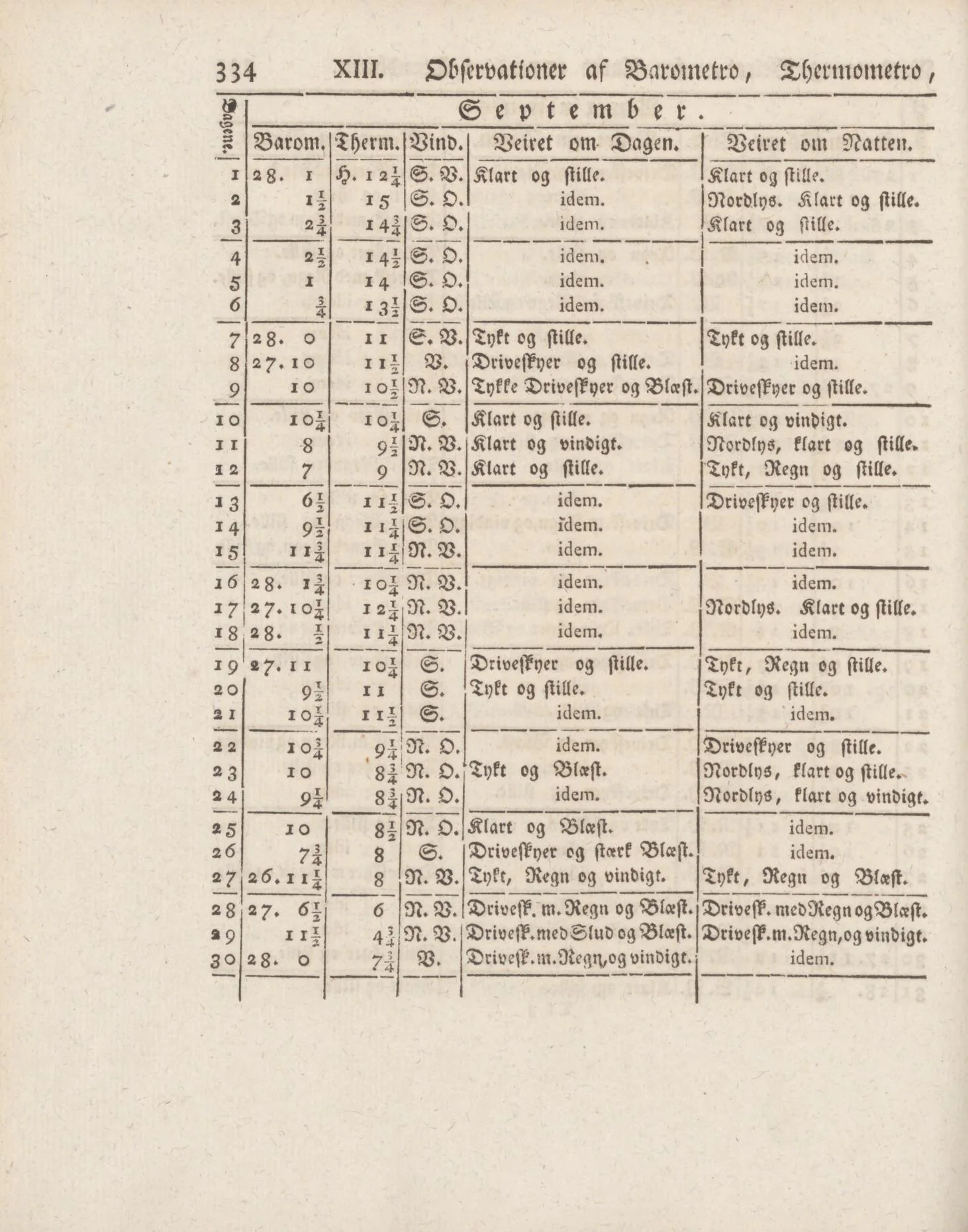
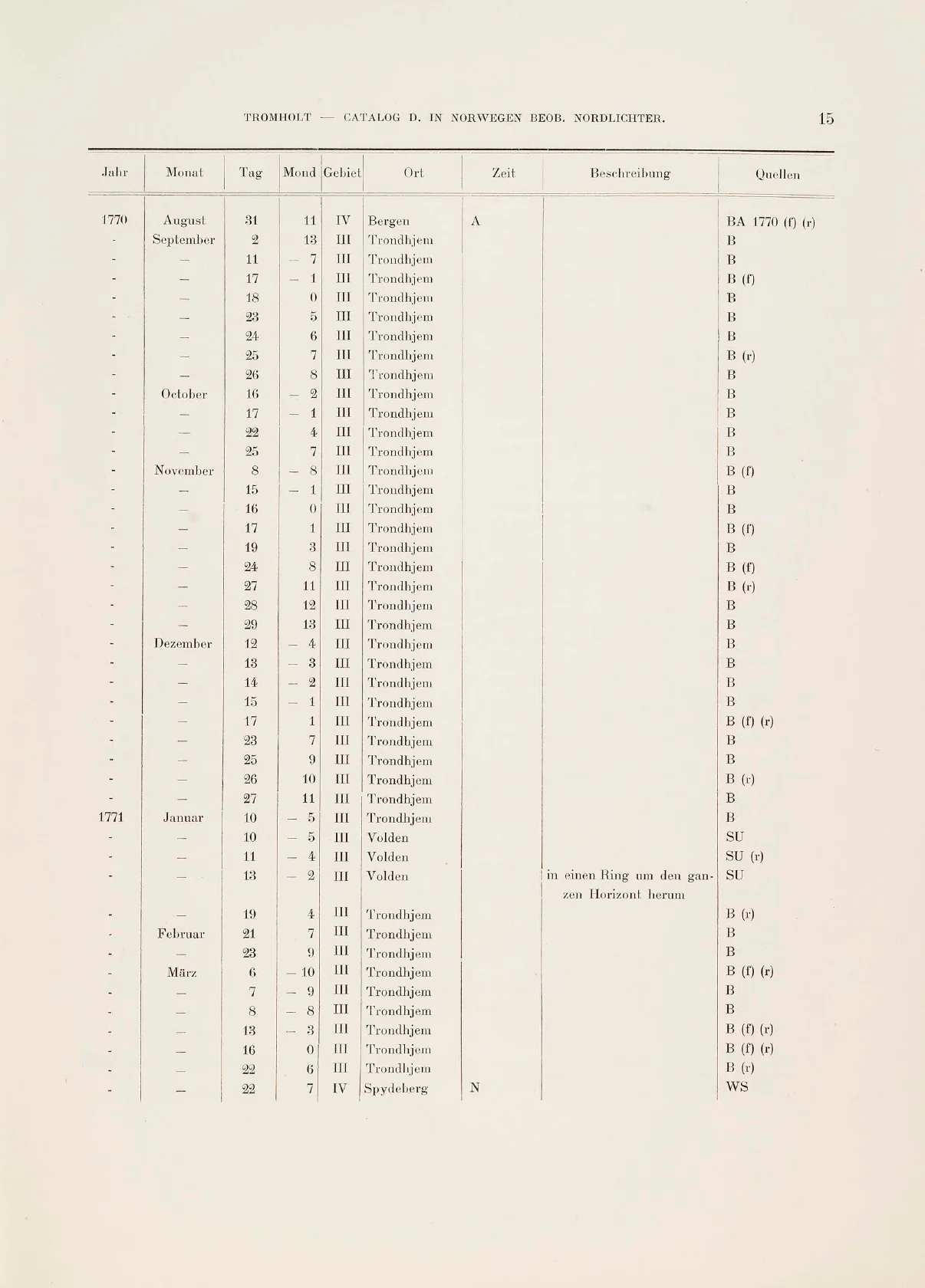
Sept 11, 17 & 18, 1770Trondhjem, NorwayJohan Daniel Berlin’s daily weather and aurora table
“9. Wind NW. [Day:] Thick drifting clouds and gale. [Night:] Drifting clouds and calm.
10. Wind S. [Day:] Clear and calm. [Night:] Clear and windy.
11. Wind NW. [Day:] Clear and windy. [Night:] Northern lights, clear and calm.
12. Wind NW. [Day:] Clear and calm. [Night:] Overcast, rain and calm.
13. Wind SE. [Day:] Same. [Night:] Drifting clouds and calm.
14. Wind SE. [Day:] Same. [Night:] Same.
15. Wind NW. [Day:] Same. [Night:] Same.
16. Wind NW. [Day:] Same. [Night:] Same.
17. Wind NW. [Day:] Same. [Night:] Northern lights. Clear and calm.
18. Wind NW. [Day:] Same. [Night:] Same [northern lights, clear and calm].
19. Wind S. [Day:] Drifting clouds and calm. [Night:] Overcast, rain and calm.
20. Wind S. [Day:] Overcast and calm. [Night:] Overcast and calm.
[Barometer and thermometer columns omitted.]”
“9. N. V. [Dagen:] Tykke Driveskyer og Blæst. [Natten:] Driveskyer og stille.
10. S. [Dagen:] Klart og stille. [Natten:] Klart og vindigt.
11. N. V. [Dagen:] Klart og vindigt. [Natten:] Nordlys, klart og stille.
12. N. V. [Dagen:] Klart og stille. [Natten:] Tykt, Regn og stille.
13. S. O. [Dagen:] idem. [Natten:] Driveskyer og stille.
14. S. O. [Dagen:] idem. [Natten:] idem.
15. N. V. [Dagen:] idem. [Natten:] idem.
16. N. V. [Dagen:] idem. [Natten:] idem.
17. N. V. [Dagen:] idem. [Natten:] Nordlys. Klart og stille.
18. N. V. [Dagen:] idem. [Natten:] idem.
19. S. [Dagen:] Driveskyer og stille. [Natten:] Tykt, Regn og stille.
20. S. [Dagen:] Tykt og stille. [Natten:] Tykt og stille.
[Barometer and thermometer columns omitted.]”
This one table gives the first European sightings found for September 11 and September 18, and shows why Trondhjem saw nothing on Sept 12–16 and Sept 19–20: rain and cloud. Sophus Tromholt’s 1902 Norwegian catalog (p. 15) reprinted these rows and marked only Sept 17 with “(f)”—meaning Fritz (1873) had a non-Norwegian sighting that day, and none of Berlin’s Trondhjem entries ever entered Fritz or NASA SPDF.
Sept 17, 1770Nîmes, FranceAimé-Henri Paulian’s Capella sightline from Montaury hill
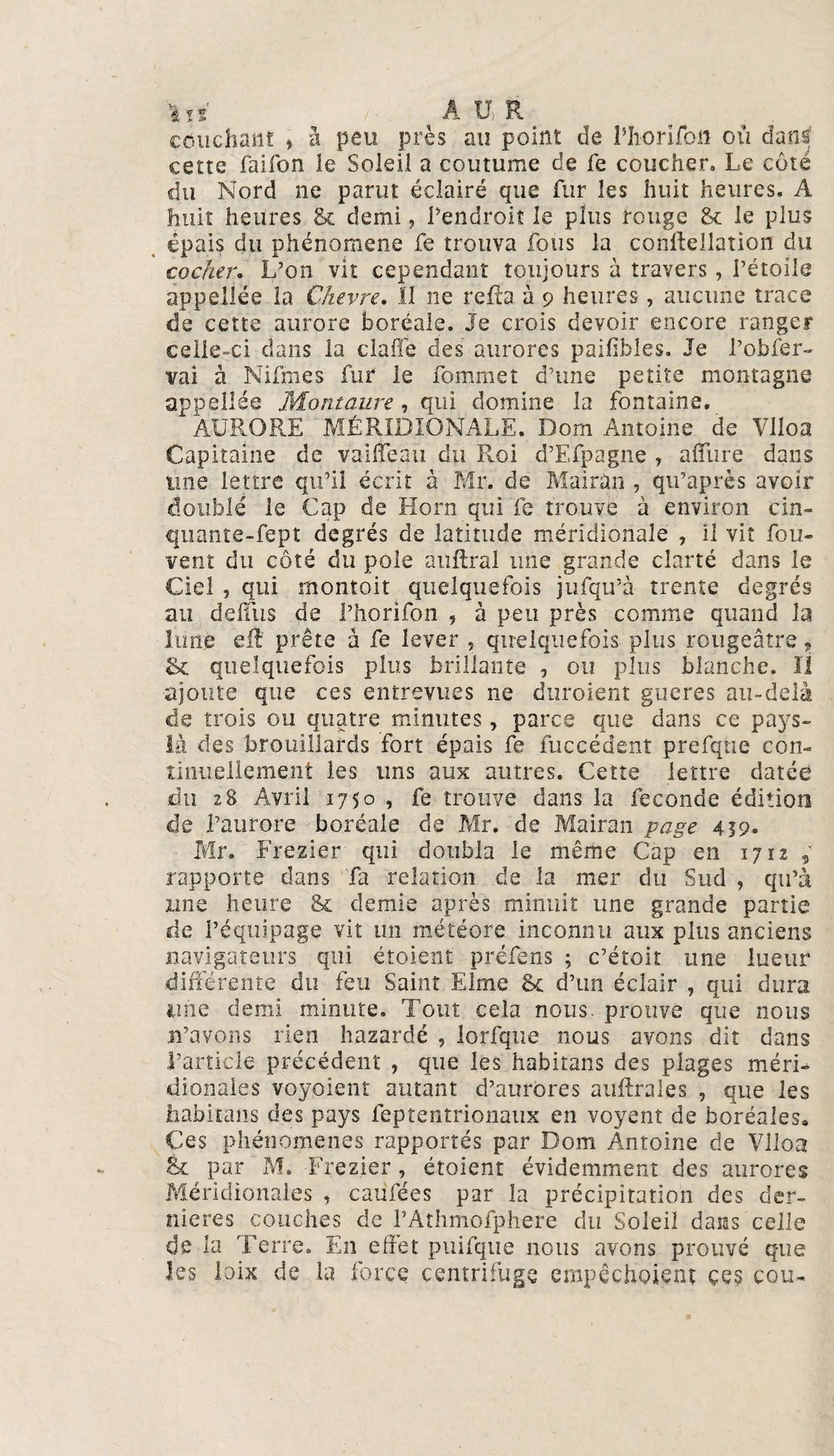
“On 17 September, around 7 o’clock in the evening, there was an aurora borealis that began toward the west… The northern side did not appear lit until about eight o’clock. At half past eight, the reddest and thickest part of the phenomenon lay beneath the constellation Auriga. One could still see through it the star called Capella. By 9 o’clock no trace of this aurora borealis remained. I believe this one too belongs in the class of quiet auroras.”
“Le 17 Septembre, sur les 7 heures du soir, il y eut une aurore boréale qui commença du côté du couchant… Le côté du Nord ne parut éclairé que sur les huit heures. A huit heures & demi, l’endroit le plus rouge & le plus épais du phénomene se trouva sous la constellation du cocher. L’on vit cependant toujours à travers, l’étoile appellée la Chevre. Il ne resta à 9 heures, aucune trace de cette aurore boréale. Je crois devoir encore ranger celle-ci dans la classe des aurores paisibles.”
Missing from NASA’s catalog, Hayakawa et al. (2017), and Yuan et al. (2026), Paulian’s Nîmes account is the most southerly dated European sighting of the storm, and the only one anywhere in Europe that fixes the aurora against a named star.
Sept 17, 1770Montmorency & BeijingLouis Cotte’s agitated compass needle & Father Amiot’s Beijing clock
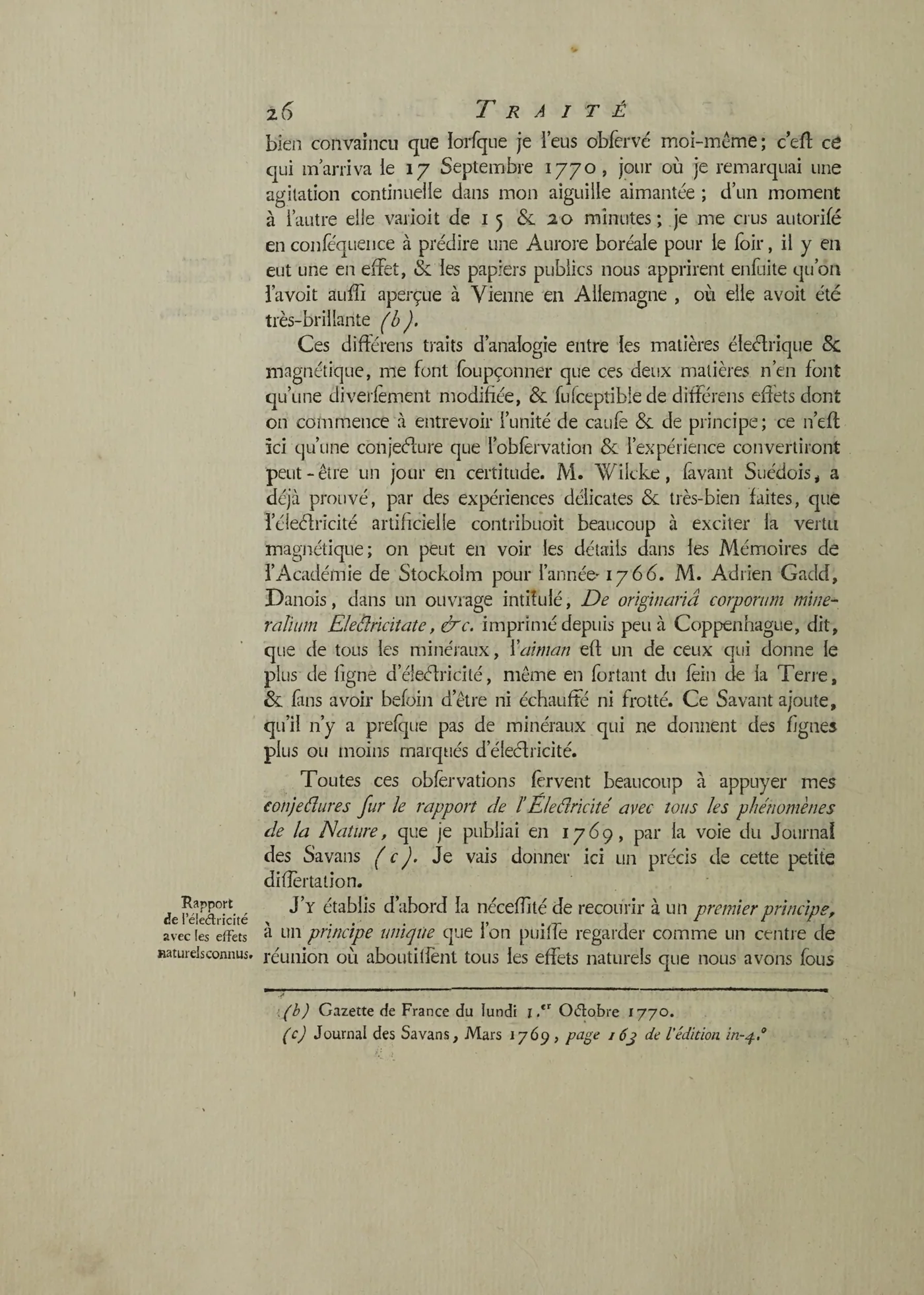
“…this is what happened to me on 17 September 1770, a day when I noticed a continual agitation in my magnetic needle; from one moment to the next it varied by 15 and 20 arcminutes; I felt justified in predicting an aurora borealis for that evening, and indeed there was one, and the newspapers later informed us that it had also been seen in Vienna, where it had been very bright.”
“…c’est ce qui m’arriva le 17 Septembre 1770, jour où je remarquai une agitation continuelle dans mon aiguille aimantée ; d’un moment à l’autre elle varioit de 15 & 20 minutes ; je me crus autorisé en conséquence à prédire une Aurore boréale pour le soir, il y en eut une en effet, & les papiers publics nous apprirent ensuite qu’on l’avoit aussi aperçue à Vienne en Allemagne, où elle avoit été très-brillante.”
In his 2nd Addition (pp. 601–602, citing the January 1773 Journal des Savans, p. 41), Cotte explicitly linked his daytime compass oscillations to Father Joseph-Marie Amiot’s observation in Beijing from 9 PM to 3 AM local (~13:15–19:15 UTC). That makes it the earliest instrument reading tied directly to the 1770 storm.
Sept 10/11, 19 & 20, 1770Norrbärke, Brunflo, Lund & Stockholm, SwedenFour Swedish manuscript sightings missed by Fritz and NASA SPDF
“1770 September 10 morning [civil Sept 11, pre-dawn] Norrbärke — high · 19 evening Brunflo (Inrikes Tidningar 1771, No. 76) · 20 [8:30 PM] Lund — faint · 20 all evening Stockholm — weak.”
“1770 Septembre 10 m. Norrbärke — élevée [Nr C] · 19 s. Brunflo [JT B an. 1771, N:o 76] · 20 [8,30] Lund — faible [ML C; Ld C] · 20 toute la soirée Stockholm — peu forte [MS C].”
Rubenson marks every sighting already in Hermann Fritz (1873) with “F”; none of these four carry “F,” so all four vanished from NASA SPDF. Because Rubenson’s astronomical day runs noon-to-noon (pp. 5–6), “10 m.” means the early morning of civil September 11—bridging Cambridge, MA (Sept 10 evening) directly to Trondhjem (Sept 11 night). Across 10 active Swedish stations, zero auroras were recorded from Sept 11 through Sept 18.
Sept 17, 1770Vienna & GurzelenDutch newspaper dispatch from Vienna & Pastor Sprüngli’s Swiss diary
“VIENNA, 19 September. Last Monday [17 Sept]… That same day one saw here, in the evening at 9 o’clock [~19:55 UTC], a very strong Northern Light. (Amsterdamsche Courant, 2 Oct 1770) · 1770. January 18: A fine northern light. February 12: A small northern light. September 17: A small northern light. (J. J. Sprüngli, Gurzelen.)”
“WEENEN den 19 September. Voorleden Maandag… Dien zelfden dag zag men hier, des avonds, ten 9 uuren, een zeer sterk Noorderlicht. (Amsterdamsche Courant, 2 Oct 1770) · 1770. Januar 18: Ein schönes Nordlicht. Februar 12: Ein kleines Nordlicht. September 17: Ein kleines Nordlicht. (J. J. Sprüngli, Gurzelen, via R. Wolf 1855.)”
Vienna’s contemporary weather chronicler Anton Pilgram (1788) missed the Sept 17 display entirely, yet it surfaced in both the French press (Gazette de France, 1 Oct) and Dutch press (Delpher). Meanwhile, Sprüngli’s exact diary words—contrasting “small” on Sept 17 with “fine” on Jan 18—independently confirm Paulian’s assessment from Nîmes.
Post-Aug 3, 1770 (undated)Cererols, CataloniaAn undated blood-red sky candidate in a Catalan farmer’s chronicle
“In the year 1770 great signs were seen in the sky. First, a comet was seen rising in the east [Lexell’s Comet, naked-eye from Aug 3]. Afterward, great blood-colored rays were seen toward the North.”
“L’any 1770 es veieren grans senyals al cel. Primerament, es veié un cometa que començà d’exir a la part del sol ixent. Desprès es veieren uns grans raigs de color de sang, a la part de Tramuntana.”
Recorded in the family chronicle of Joan Fàbrega of Cererols (El Bages, near Barcelona) and catalogued by Enric Aragonès and Jorge Ordaz (2010, entry 17), who favor [17 September 1770?] over 31 August because of Paulian’s Nîmes sighting 280 km northeast. Because the chronicle gives no day, it remains a low-confidence candidate—and notably, no dated Spanish, Portuguese, or Canary Islands archive records September 1770 at all.
Methodology: how the search was done
Historical space weather is an unusually clean proving ground for agentic archival research because the target window is razor-narrow (ten nights in September 1770) and the physical signatures—red sky, northern/southern lights, compass-needle agitation—are unmistakable across languages. Still, a naive keyword sweep would have produced at least five serious errors. Four checks guarded against them:5
- Checking NASA’s files and the published papers first. Before trusting any hit as “new,” we downloaded and inspected NASA SPDF’s exact text files (
misc/temp01.txt,silv1nts.txt, andane720t.txt) alongside Hayakawa et al. (2017) and Yuan et al. (2026). That immediately revealed both what the digital baseline was missing (Sweden, Norway, Nîmes, magnetic-needle readings, weather controls) and the liveSept 16date bug inane720t.txt. - Testing the search on the January 1770 aurora. Eight months earlier, a massive aurora lit up Europe down to Cádiz, Naples, and Tenerife (+36° MLAT). Whenever our queries across Delpher Dutch newspapers, Iberian catalogs, Swedish/Norwegian journals, or Wilcke’s Stockholm memoirs lit up with January 18, 1770 hits—and returned silence for September 1770—that proved our retrieval pipeline had high recall and that the September silence in southern Europe was physically real rather than a search failure.
- Allowing for slow mail and other words for the sky. Because news from India, Java, Mauritius, and the Caribbean took two to six months to reach London and Amsterdam, we swept British and Dutch periodicals through mid-1771, and searched VOC Dutch archives for descriptive sky terms (luchtverschijnsel, zuiderlicht, roode/vuurige lucht, bloedrood, compas) rather than just “aurora.”
- Checking dates, citations, and page images by eye. Direct scan and convention checks caught five classic historical traps: (a) St. Petersburg Old Style dates (+11 days, shifting Euler’s Sept O.S. table to Sept 12–Oct 11 N.S.); (b) Rubenson’s noon-to-noon astronomical day (meaning Norrbärke “10 m.” is civil morning Sept 11, and Lund OCR “3,30” is 8:30 PM); (c) publication lag (Swedish Academy 1770 printed the 1769 comet; Duhamel’s “stationary needle” belonged to Dec 1770 and his Sept 6 storm was 1771); (d) false-positive “Aurora” homonyms (the lost British frigate HMS Aurora dominated late-1770/1771 British and VOC hits); and (e) OCR drift (inspecting Cotte’s original p. 26 scan corrected “15 à 20” to “15 & 20 minutes” and pinned Paulian’s Nîmes entry to pp. 211–212).
Data and next steps
For space-weather modelers and historians wishing to ingest these records into geomagnetic reconstructions (e.g., testing UT-localized substorm / ring-current models against the 1770 GUFM1 dipole), the complete structured dataset—39 rows covering every newly recovered observation, NASA SPDF comparison flag, clear-sky control, overcast control, and verified dry well—is available as a single CSV file:
Download structured dataset (CSV · 39 records) ↓
Night-by-night table
The same information as Exhibit 1, as a table: every sighting, north and south, alongside the recorded weather.6
| Date | N. America (+52.2°) | Britain (+56.2°) & France (+48°–53.4°) | Central Europe (+50.2°–56.6°) | Norway (+65.7°) & Sweden (+57.9°–64.6°) | East Asia (+19°–30°) & Timor (−20.7°) |
|---|---|---|---|---|---|
| Sept 9 | Aurora (Winthrop, Cambridge) | Denainvilliers: partly cloudy | Aurora (Berlin) | Trondhjem: drifting clouds | Quiet |
| Sept 10 | Aurora (Winthrop, Cambridge)* | Denainvilliers: partly cloudy | — | Aurora (new): Norrbärke (10 m. = night 10–11); Trondhjem clear, none | Storm onset (low East Asian counts) |
| Sept 11 | — | Denainvilliers: overcast | — | Aurora (new): Trondhjem (Nordlys, klart) | Sparse East Asia |
| Sept 12–13 | — | Denainvilliers: rain / variable | — | Trondhjem: rain (12), clouds (13) | Sparse East Asia |
| Sept 14 | — | Denainvilliers: clear, no aurora | — | Trondhjem: drifting clouds | East Asia active |
| Sept 15 | — | London: very fine, no aurora | — | Trondhjem: drifting clouds | East Asia active |
| Sept 16 | SPDF 9/16 is a Lovering typo* | London & Denainvilliers: clear, no aurora | — | Trondhjem: drifting clouds | Major surge + HMS Endeavour off Timor |
| Sept 17 | — | Aurora (new): Nîmes (Capella → +56° MLAT); Montmorency needle 15′–20′ + aurora; Paris, Burgundy; London gloomy; Denainvilliers clear, none | Burst: Vienna (9 PM), Gurzelen (kleines), Böhringen, Berlin, Lübeck; Catalonia candidate | Aurora (new): Trondhjem (Nordlys, klart); 0 across 10 Swedish stations | GLOBAL PEAK (74/111 records) + Amiot Beijing (13:15–19:15 UTC) |
| Sept 18 | — | London & Denainvilliers: clear, no aurora | — | Aurora (new): Trondhjem (Nordlys, klart); 0 in Sweden | Strong East Asia (VOC Dejima: nothing to note) |
| Sept 19 | — | London: stormy; Denainvilliers: cloudy | — | Aurora (new): Brunflo (eve); Trondhjem rain | Final East Asian night |
| Sept 20 | — | Denainvilliers: cloudy | Aurora (Böhringen) | Aurora (new): Stockholm (all eve) & Lund (faint); Trondhjem overcast | Quiet |
Where nothing was seen
Knowing where the aurora was not seen, and whether the sky there was clear, cloudy, or simply unrecorded, matters as much as finding new sightings:
| Archive / Source | Region & 1770 MLAT | What we checked | Result & diagnostic value |
|---|---|---|---|
| Guillaume Le Gentil, Voyage dans les mers de l’Inde (T. 1–2, 1779–81) | Port-Louis, Mauritius (−24.0°) | Full text of both volumes; Le Gentil stayed on Mauritius 16 Apr–19 Nov 1770. | Nothing found. Logged an April 19 atmospheric flash and Lexell’s Comet, but zero Sept 1770 aurora or compass anomalies—despite sitting 3.3° poleward of HMS Endeavour off Timor. |
VOC / GLOBALISE (voc.sqlite, 1770–71) |
Batavia (−15.9°), Timor, Dejima (+22.6°), Canton, Bengal, Cape | FTS5 sweep for aurora, red/fiery sky, meteors, and compass terms + direct inspection of Sept 1770 station dagregisters. | Nothing found. Dejima Sept 18 reads “Niets te noteeren.” All “aurora” hits were ship names (HMS Aurora), enslaved women, or bastion names. |
| Iberian & Canary archives (Aragonès & Ordaz 2010; Carrasco et al. 2018) | Spain, Portugal, Canaries (+36.0° to +46.5°) | Complete 18th-century catalogue (80 auroras) + Gaceta de Madrid. | 0 dated Sept 1770 sightings (only undated Cererols chronicle entry). Strong contrast with 18 Jan 1770, seen at 35 sites down to Tenerife (+36.0°). |
| Delpher Dutch newspapers (1770–71) | Europe + delayed colonial mail | 1770–71 SRU sweep for noorderlicht, zuiderlicht, luchtverschijnsel, vuurige/roode lucht. | Search confirmed working: flooded with Jan 18, 1770 reports from Lisbon, Cádiz, Naples, Genoa, and Warsaw—yet carried only Vienna Sept 17 for September 1770. |
| Johan Carl Wilcke, K. Sv. Vet. Acad. Handl. v. 38 (1777) | Stockholm (+60.5°) | Full magnetic-needle memoir and tables (pp. 273–300). | Too late to help: Wilcke’s continuous daily Stockholm declination journal began in October 1771—13 months after the storm (he cites only the 18 Jan 1770 dip-needle event). |
| Johann Albrecht Euler, Novi Comm. Petrop. t. 15 (1770) | St. Petersburg (+58.9°) | Meteorological tables (pp. 676–683), Julian Old Style (+11 days). | Cloudy month: Sept 1770 O.S. (= Sept 12–Oct 11 N.S.) had only 2 clear days, 5 foggy, 10 rainy, and 0 auroras—explaining Russian silence. |
| Duhamel du Monceau (Denainvilliers) & Gentleman’s Magazine (London) | N. France (+52.6°) & Britain (+56.2°) | Daily weather tables for September 1770. | Clear, no aurora: Clear skies on Sept 14, 15, 16, and 18 with zero auroras; London was “gloomy” on Sept 17. (Duhamel’s “stationary needle” note belongs to Dec 1770; his Sept 6 storm was 1771.) |
| Alzate (Mexico), Washington (Mount Vernon), APS Vol. 1, LOC, British & Norwegian press | Americas (+26.8° to +52°) & Norway | Alzate (1770/72), Washington Diaries Vol. 1, APS 1769–71, Chronicling America, Nov 1770–Apr 1771 British magazines, all 15 Sept–Oct 1770 NB.no Norwegian issues. | Nothing found. Alzate’s 1770 print covered 1769; late 1770/71 British press “Aurora” hits referred to the missing frigate HMS Aurora; Norwegian press caught Feb 1770 but missed Sept 1770. |
Where to look next
This sweep closes most open digitized European academy volumes and Dutch Asian archives, leaving four sharply defined manuscript or paywalled targets that could push the 1770 reconstruction even further:
- Nicolaus von Béguelin’s 1770 Berlin Academy memoir. Harvard’s digitized run of Nouveaux mémoires de l’Académie Royale des Sciences et Belles-Lettres skips Année MDCCLXX (Berlin, 1772, pp. 75–96). Béguelin kept daily weather, aurora, and magnetic-needle notes (confirmed from his 1771 volume); reading his actual 1770 pages would test whether Berlin recorded a numerical compass deflection on Sept 9 or Sept 17 alongside Cotte’s Montmorency reading.
- Giuseppe Toaldo’s Padua register (+48.3° MLAT). Toaldo’s first edition (dated 20 Sept 1770) stops at winter 1769–70, and the modern catalog of his 1766–1797 Padua manuscript logs (Domínguez-Castro et al., SWSC 6, A21, 2016) sits behind a DataDome check. Verifying whether Padua logged clear skies or an aurora on Sept 17 would pair directly with Paulian’s Nîmes (+48.0°) sightline.
- Unpublished Swedish observatory weather logs (Sept 11–18). Rubenson (1879) extracted aurora sightings from manuscript registers at Stockholm (
MS C), Uppsala (Mt C), and Lund (ML C; Ld C), showing zero Swedish auroras between Sept 11 and Sept 18. Checking the underlying sky-cover columns in the Royal Swedish Academy archives would establish whether Sweden was clouded out on Sept 17–18 or genuinely quiet on Sept 18 while Trondhjem (+65.7°) glowed. - 1770 British East Indiaman, Royal Navy, and Moravian logs. No 1770 ship logs outside HMS Endeavour have been systematically read for Sept 10–19. British Library India Office logbooks (
IOR/L/MAR/B) for ships crossing the Indian Ocean and South Atlantic in September 1770, Royal Navy captains’ logs (TNAADM 51), and Moravian mission diaries in Greenland and Labrador remain the best chance of adding a second Southern Hemisphere or North Atlantic sighting.7
Notes and sources
-
1
Foundational baseline papers: Hisashi Hayakawa et al., “Long-lasting extreme magnetic storm activities in 1770 found in historical documents,” ApJL 850:L31 (2017); D. M. Willis, F. R. Stephenson & J. R. Singh, “Auroral observations on AD 1770 September 16: the earliest known conjugate sightings,” QJRAS 37 (1996), 733–742; and H. Yuan, Z. Yin, Z. Xu et al., “Multi-day extreme geomagnetic storm in September 1770,” Frontiers in Astronomy and Space Sciences (2026).
-
2
Primary sources for the newly integrated records: Johan Daniel Berlin, Nye Samling af det Kongelige Norske Videnskabs-Selskabs Skrifter (1784), p. 334, and Sophus Tromholt, Catalog der in Norwegen (1902), p. 15; Robert Rubenson, Catalogue des aurores boréales observées en Suède (1879), p. 114; Aimé-Henri Paulian, Dictionnaire de physique, T. 1 (1773), pp. 211–212; Louis Cotte, Traité de météorologie (1774), p. 26 & pp. 601–602; and John Winthrop in Joseph Lovering (1867), entry 158, p. 363 vs. Lovering (1868), p. 60 and NASA SPDF
ane720t.txtL667. -
3
Clear-sky and overcast controls: H.-L. Duhamel du Monceau’s daily Denainvilliers weather log in Hist. Acad. Roy. Sci. Paris 1771 (1774), pp. 818–819; London meteorological diary in The Gentleman’s Magazine (Aug 1771), Sept 1770 table; J. A. Euler’s St. Petersburg weather counts in Novi Comm. Petrop. t. 15 (1770), pp. 676–683; and J. J. Sprüngli’s Gurzelen diary in Rudolf Wolf, Mittheilungen der Naturforschenden Gesellschaft in Bern (1855), p. 40.
-
4
Capella (α Aurigae) precessed from J2000 (RA 5h 16m 41s, Dec +46.00°) to epoch 1770.71 gives RA 4h 59m 45s, Dec +45.76°. At Nîmes (43.84°N, 4.36°E) on 1770-09-17 20:30 local apparent solar time (~20:07 UTC, JD 2367799.338), Capella stood at Alt 9.2°, Az 31.7° (NNE). Using Earth radius 6,371 km and a standard 400 km red-oxygen (630.0 nm) emission altitude yields a ground distance of 12.6° (54.1°N, 15.6°E = +56.0° MLAT in the 1770 GUFM1 dipole).
-
5
Archives swept: Biodiversity Heritage Library (Paris, St. Petersburg, Stockholm, Uppsala, Bern, Zurich, Philadelphia), National Library of Norway API (
api.nb.no), UiT Septentrio (Tromholt 1902), Internet Archive / Wellcome Collection, Delpher Dutch newspapers (1770–71), Library of Congress Chronicling America, Harvard Institutional Books, GLOBALISE/VOC SQLite (1770–71), RACO / Museu de Ciències Naturals de Barcelona, and NASA SPDF. Three external gates hit anti-bot walls and were not bypassed: ANNO (Wienerisches Diarium), HathiTrust (replaced cleanly by UiT’s open-access Tromholt PDF), and SWSC / DataDome (Domínguez-Castro et al. 2016 Padua table). -
6
All geomagnetic latitudes in the CSV and tables are computed in the 1770 GUFM1 dipole frame (north geomagnetic pole at 79.8°N, 303.4°E, matching Hayakawa et al. 2017, Fig. 2). Controls reproduce published values within 0.5°: Dongtinghu +19.3° MLAT, HMS Endeavour off Timor −20.7° MLAT.
-
7
For the Spanish 18 January 1770 baseline and Cererols chronicle entry, see Enric Aragonès Valls & Jorge Ordaz Gargallo, Treb. Mus. Geol. Barcelona 17 (2010), 45–110, and V. M. S. Carrasco et al., HGSS 9 (2018), 133–139. For Wilcke’s Stockholm needle start date (Oct 1771), see K. Sv. Vet. Acad. Handl. v. 38 (1777), p. 279; for Le Gentil on Mauritius, Voyage dans les mers de l’Inde, T. 2; for Washington at Mount Vernon, Diaries, Vol. 1, pp. 396–398.