Vienna · Edison cylinder EDIS 93953 · 1889–90 collection
A voice from Vienna
When Thomas Edison’s recording engineer Theo Wangemann took a phonograph to Europe, an American in Vienna used it to dictate a letter. He talked about the children and the apartment. The wax cylinder survived. The box it came in had no list of speakers.
How do you put a name to a voice when nobody alive could recognize it? Here, two things helped. The cylinder made much the same swishing noise every time it turned, which gave us a way to quiet it. And the man happened to mention something his family had put on paper.
What does he call the children?
Listen for the name just after “baby brother.” Try the archive audio and the cleaned version before opening the two readings below.
0:20.8–0:31.0 of the full recording · NPS transfer
The audio could not be loaded. The NPS transfer is linked above.
Read what two listeners heard
- Published by the National Park Service
- “… your baby brother and Julius.”
- Benjamin Breen’s reading
- “… your baby brother and Julia.”
The last syllable is hard to hear in both copies. A few seconds later the speaker says that the boy is doing well at school. Published transcript.
What did he send home?
About a minute in, the man mentions Ida. Then he recalls sending someone a plan of his apartment in a letter. That detail gave us something specific to look for in family papers.
Noise reduced · 1:00–1:16 of the full recording
Hear the same passage before cleanup
An apartment plan and a school register
One American family in Vienna fits both passages. Frederick Dent Grant, the U.S. minister to Austria-Hungary, lived there with his wife Ida, their daughter Julia and their son Ulysses. Two documents let us check more than the names.
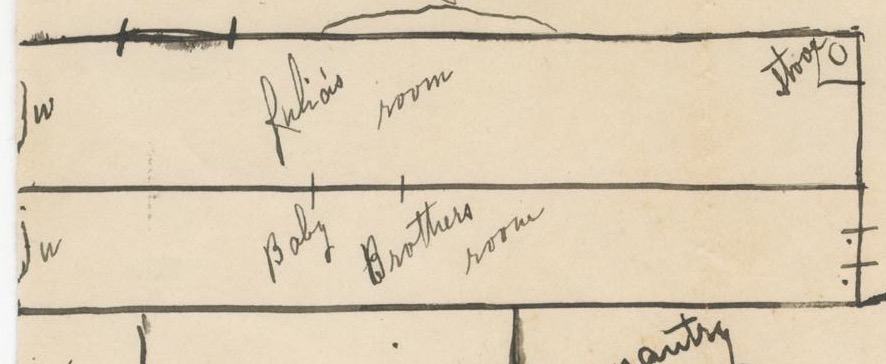
Julia’s rooms
On June 26, 1889, Julia sent her grandmother a plan of the family’s new flat. She labeled two rooms “Julia’s room” and “Baby Brothers room.” This drawing is earlier than the plan the speaker says he sent. It shows that this family sent floor plans home and used the same expression for the boy.
Full drawing, scan 7 · Julia’s letter, Mississippi State University Libraries. Detail rotated for reading.

Her brother’s school
The Theresianum in Vienna listed Ulysses S. Grant of Chicago among the pupils who earned a first-class certificate in 1889–90. In December, Ulysses himself wrote to his grandmother about how much he liked his lessons. The subject of the spoken letter was also news the family sent in writing.
School report, printed p. 61 · Ulysses’s letter, December 8, 1889
Frederick Dent Grant is our best candidate. The American consul-general in Vienna, Julius Goldschmidt, also had a wife named Ida. What favors Grant is the combination of the schoolboy, his sister’s drawing and the way she referred to her brother. We still lack a letter or diary entry placing Grant at Wangemann’s phonograph. The speaker’s “your baby brother” also leaves open whom he was addressing.
What could this do for another recording?
When a speech-recognition program was given overlapping excerpts without being told what name to expect, it returned both “Julia” and “Julian.” Those are spellings an archivist can search for. The next question is one the software cannot answer from the sound alone. Did any of the families who turn up in that search have a boy at school in Vienna, and did they send drawings of their apartment to relatives?
The same approach could help with an unlabeled film. Suppose a parade passes a shop whose sign is legible for just one frame. A city directory could put that shop on a particular corner. A newspaper could then tell you which parades went down that street. Keep the frame, the directory entry and the competing dates together, so the next person can test the identification.
Methodology
On the National Park Service’s 2011 transfer, a swish returns about every four-tenths of a second as the cylinder turns. We compared the same part of neighboring turns to estimate which frequencies belonged to the swish, then lowered them where it was loudest. You can compare the complete recording with the filtered version. Both preserve the timing of the voice. Where the swish overlaps a syllable, the name is still hard to hear.
We checked the possible names against details elsewhere in the recording. The speaker remembers sending a plan of his apartment and says a boy is doing well at school. We looked for a family in Vienna that fit both clues. Julia Grant’s drawing and a school register naming her brother give us two independent checks. We still lack a document placing their father at the phonograph.