Pachacámac, Peru · Andean records
Did two sets of knotted cords keep the same account?
People in the Andes kept records by tying knots in cords. Two objects from the coast of Peru preserve a run of numbers in the same order. Even one cord that broke long ago offers a clue.
Line up the cords ↓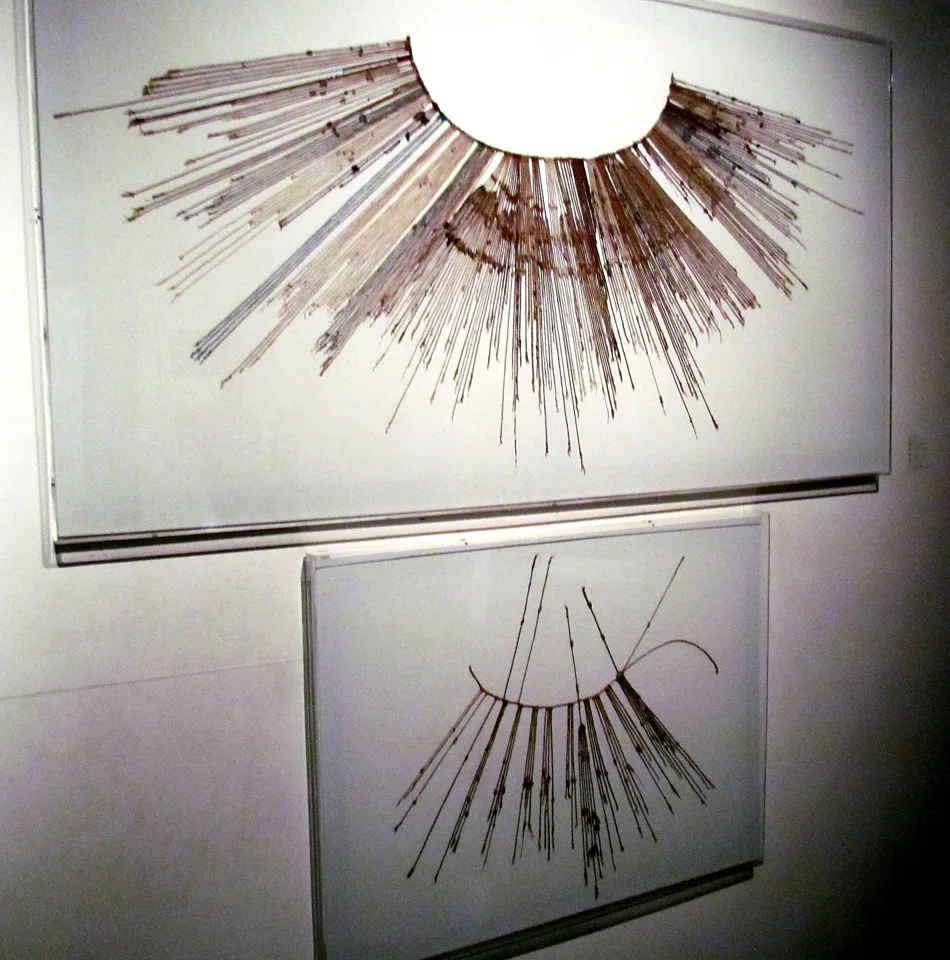
How do you read a number from string?
A khipu is a record made of cords. Shorter cords hang from a main cord, and on many khipus the positions of knots tell you which stand for hundreds, tens and ones. Someone can read the number 470 from a cord today even if the name of the thing being counted has been lost.1
Two khipus in Berlin’s Ethnological Museum are recorded as coming from Pachacámac, near Lima on the coast of Peru. One has 15 main hanging cords, the other 62. On the shorter one, two groups of seven cords sit side by side. On the longer one, two groups of seven sit in the same order. The interesting part is what happens when you line up the numbers inside them.2
Line up the cords
Keep the short khipu still and move the long one beneath it. Look for a run of numbers that agree. Each column compares one cord from each object.
7 of 8 numbers match · long cords 7–20
| Cord on short khipu | 2 | 3 | 4 | 5 | 6 | 7 | 8 |
|---|---|---|---|---|---|---|---|
| Short | 620 | 470 | 528 | 935 | 474 | 319 | 453 |
| Long | 620 | 470 | 528* | 932 | 474 | 319 | 453 |
| Result | Match | Match | Set aside | Different | Match | Match | Match |
| Cord on short khipu | 9 | 10 | 11 | 12 | 13 | 14 | 15 |
|---|---|---|---|---|---|---|---|
| Short | 492 | 6?? | ?? | ?? | 4?? | ?? | 275 |
| Long | 492 | 663 | 252 | 654 | 423 | 433 | 275 |
| Result | Match | Broken | Broken | Broken | Broken | Broken | Match |
✓ Match ≠ Different ? Broken — Set aside
A question mark stands for a lost digit or reading. An asterisk marks long cord 9. The modern record gives it 528, the older table gives it 0. The score skips short cord 4 at every setting. In the proposed match, that is the cord facing the disputed 528.
What survives the breaks?
Start at cord 7 on the long khipu. The two records agree on 620, then 470. Farther along, both give 474, 319, 453 and 492 in succession. Even beyond several breaks in the shorter khipu, both records end this stretch with 275. One broken cord still carries knots for six hundreds. Its partner reads 663. That is a possible fit, but the missing digits keep it out of the score.3
One cord matters especially. An older table gives long cord 9 a value of 0. The modern database gives it 528, exactly the number on its partner. Set that pair aside and seven of the eight fully readable comparisons still agree. The one difference is small enough to inspect on the objects themselves. One cord reads 935 and the other 932. The disagreement comes down to the last knot.4
How the search worked
A research agent searched for short runs of numbers recurring on two khipus from the same place. It checked museum numbers to rule out two catalogue entries describing the very same object. Then it set the disputed reading aside and tried the eight remaining comparisons at every possible starting place in 87 other records attributed to Pachacámac. Among 3,452 stretches of cord, this one gave seven matches. Every other object gave at most one.5
What might two matching records mean?
One keeper of accounts might have copied part of a longer record. Two keepers might also have written down the same quantities independently. Either possibility would give historians a way to study how accounts travelled between people. An earlier study paired the long khipu with a different object of the same length. The comparison here concerns just fourteen cords.6
The most valuable next evidence would be close photographs or the original recording notes for cords 9 and 10. They could settle the disputed 528 and show whether the final knot really differs by three turns. What the numbers stood for remains open.
Notes and sources
-
1
The Khipu Field Guide illustrates how knots are tied, how their positions are recorded, and how to read a catalogue diagram.
-
2
The museum lists separate objects, VA 42601 (short) and VA 42559 (long). See the cord diagrams for KH0132 and KH0456.
-
3
Marcia and Robert Ascher drew and described the shorter object, including its broken ends. See their original AS118 recording, pp. 791–793.
-
4
The 62 values in Gary Urton’s table UR218.xls (ZIP) add to 8,282. In the Open Khipu Repository v2.1.0 they add to 8,810. Cord 9 accounts for the entire difference. The Field Guide workbook supplies the long record used in the exhibit.
-
5
These counts use the principal hanging cords in the repository and omit entries already marked as duplicates. The eight positions were chosen after the pair had come to light. The saved search results list the highest-scoring stretches, the positions checked and the comparison restricted to pairs of seven-cord groups.
-
6
Gary Urton lists whole-object pairs on p. 36 of Quipus de Pachacamac (2014). The museum record includes a photograph of the long khipu.