The Mississippi River, 1792 · Espionage
A dictionary for Agent 13
In 1792 James Wilkinson was a U.S. Army officer and a paid spy for Spain. His Spanish contacts called him Agent 13. Kentucky farmers shipped their crops down the Mississippi River to New Orleans, a port Spain controlled. Wilkinson had even proposed bringing Kentucky itself under Spanish protection.
One letter in this secret correspondence came from Natchez, then a Spanish-ruled town upriver from New Orleans in what is now Mississippi. To hide a word from anyone who might open the mail, the writer gave its place in a dictionary. A reader with the same edition could turn to page 163, count down to the 26th entry in the left column, and read glorious.
We know some of the words because someone wrote them in above the numbers. Other letters still have gaps. Could John Entick’s pocket dictionary be the book that would let us fill them in?
Try the letter against the book
We know that people used Entick’s New Spelling Dictionary to send secrets. In 1781 the American diplomat John Jay warned a friend that his mail would probably be opened. He told him exactly which dictionary to get for their letters, right down to the year on the title page. Jay had bought his own copy at a bookshop in Philadelphia.
Did Wilkinson and his Spanish correspondents choose Entick too? They had a separate list of numbers for names and common words. It is the other words that let us test the dictionary. In their transcription of the Natchez letter, dated March 20, 1792, researchers give 163.[26]- for glorious. The dash means the left column. Two entries farther down should be glory. Try that pair in the 1785 printing, then try a word from the end of the letter, water.
Transcribed codes for glorious and glory · Chu, Valenti and Knight on how the letters were read
Glorious & glory
- Where the letter points
- Page 163, left column, entries 26 and 28
- London, 1785
- Page 167, right column, entries 3 and 5
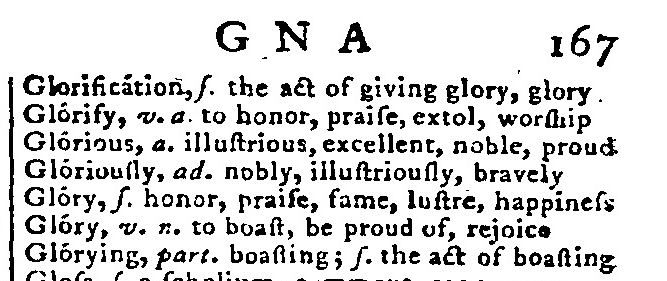
Count down from Glorification. The word in between is just what we hoped to find. The trouble is that the letter sends its reader four pages back, to the other column. The actual page 163 runs from Gantlet to Gazetteer.
Advanced & advantageous
- Where the letter points
- Page 7, right column, entries 20 and 26
- London, 1785
- Advanced ends page 7. Advantageous is entry 6 on page 8, left.
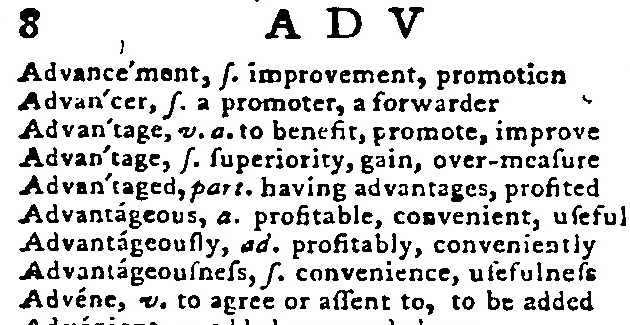
Advanced is the last headword on page 7. Turn the page and count six entries. The words are the right distance apart, but they fall on opposite sides of a page turn. Renumbering the pages would still leave them there.
Water
- Where the letter points
- Page 422, right column, entry 14
- London, 1785
- Page 429, left column, entry 11
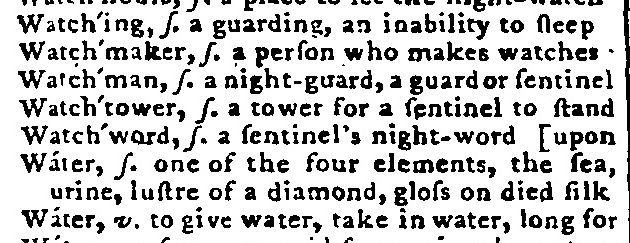
Near the end of the letter someone is to be sent “by land or by water.” That gives us a noun to look up. The 1785 printer put it just below Watchword. On page 422 both columns are still in U.
What a printer could change
In London in 1774, a reader could find glorious and glory in the left column, with gloriously between them. They sat at entries 21 and 23 on page 178. By 1782 the same three words appeared on page 158, on the right. The 1785 and 1786 printings agree on page 167, right down to the line. Even if we find the layout Wilkinson’s correspondents knew, the words alone may never tell us the year on their title page.
London 1774, p. 178 · London 1782, p. 158 · London 1786, p. 167
How did we search the other dictionaries?
We searched machine-readable text from 81 scans catalogued before 1792. Pages 7 and 163 are 156 pages apart in any complete copy, however many leaves of preface the binder put at the front. None of the scans yielded both pairs at that distance. Widening the search by two pages produced one tempting result. In John Marchant’s dictionary, advantageous helps define conducible, and advanced occurs in the definition of confirmation. Both hits are on a page headed CON. Old type also defeats text recognition, so a failed search can overlook a good candidate. Counting down the printed column is the decisive test.
Were the words borrowed from another letter?
On May 26, 1797, the Baron de Carondelet, Spain’s governor in Louisiana, issued an order. Its published English translation contains five words also found in the Natchez letter. The order reads glorious, glory, expect, brilliant, fortune. In the 1792 letter the five appear in exactly the reverse order. That comparison rests on the researchers’ transcription of manuscript pages 2880–2882. We have yet to check the sequence against images of the handwritten pages.
Carondelet to Thomas Power, enclosure 38, p. 103 · Readings in the order of the 1792 letter
One page worth turning
The Huntington Library holds a copy of Entick which its catalogue dates to about 1784. It ends at page 470, well past all three places we need. We found the catalogue record but no public scan. A photograph of page 163 would answer the first question. If the two words land in the right places, turn to pages 7 and 422. If those match too, there are dozens of other known words to check before trying the book on a dispatch we still cannot read.
Huntington Library, rare book 480434 · The open problem of Wilkinson’s dispatches →
Methodology
We started with the researchers’ transcription of the Natchez letter. It gives us five words to look for on three pages. We searched the machine-readable text of 81 dictionary scans for pairs of words the right number of pages apart. A word in a definition can look like a match in a text search. On the scanned page you can see whether it has an entry of its own.
For five London printings of Entick, we found glorious and glory on the page and counted entries from the top of the column. None put both words where the letter says they belong. We also checked advanced, advantageous and water in the 1785 copy. Any future candidate has to put all five in place before we try it on an unread passage.