The Mississippi River · 1792
Which dictionary did Agent 13 use?
In 1792, James Wilkinson was a U.S. Army officer and a paid spy for Spain. AI agents used a coded letter about his pay to test an old suspicion about the dictionary he and his Spanish contacts used to hide words in their mail.
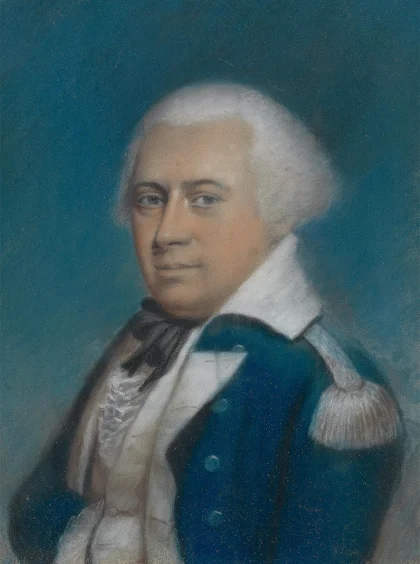
Portrait at Yale
Kentucky farmers shipped their crops down the Mississippi River to New Orleans, the port that gave them access to the sea. Spain controlled the port. Wilkinson, who had traded there himself, went so far as to propose bringing Kentucky under Spanish protection. His Spanish contacts called him Agent 13.1
A letter about his pay
Upriver from New Orleans, in what is now southwestern Mississippi, lay the Spanish-ruled town of Natchez. A letter written there on March 20, 1792, brought Wilkinson news of his Spanish pension. A thousand dollars would be due at the end of the year.2
An intercepted letter could have exposed Wilkinson. Where a stranger would have seen only numbers, his copy of the dictionary supplied the word pension. Here is how researchers transcribed that part of the letter.
269.[26]-Open the dictionary to page 269. The single stroke means the left column. Count down to the 26th entry to find pension.
Both people needed copies with the same words in the same places. For names and many common words they also kept a separate numbered list. That is why some words in the manuscript appear as a single number and others take a pair.
Two copies of the same passage
These details come from another letter in Wilkinson’s correspondence.3


In the lower copy you can make out “the man you described” under the first row of numbers. Wherever someone supplied the English, we can tell what those numbers meant without having the book at hand.
How much can we already read?
Some letters survive with a reading made at the time. In 2009 the historian Austin Wheeler printed both the coded and the deciphered versions of a letter Wilkinson sent in April 1797 to Manuel Gayoso de Lemos, a Spanish colonial official. Wheeler also printed a letter from 1799 for which he had only the code. The correspondents changed their code over the years, so a key to one exchange could be useless for another.
In 2020, Christopher Chu, Raphael Valenti and Kevin Knight used the letters with known readings to draw up a list of numbers and their meanings. When they encountered an unfamiliar number, they could use its place in the alphabet and the sense of the sentence to suggest a word. On a letter whose English reading they had set aside to check their results, their computer recovered about three words in four. They also proposed a reading for a letter with no known decipherment. For that letter, how many words they got right remains an open question.4
The search for the book
Finding a matching dictionary would let us look up the remaining words in letters that used it. Historians had long suspected John Entick’s New Spelling Dictionary. It was certainly used for secrets. In 1781, the American diplomat John Jay told a friend that his mail would probably be opened and named the precise London printing of Entick to buy. Wheeler proposed another possibility for Wilkinson’s Spanish correspondence, William Perry’s Royal Standard English Dictionary, which appeared in an American printing in 1788.5
What AI agents found
AI agents started with the published readings of the Natchez letter. Two numbers in it give unusually precise directions. On page 163, the left column should have glorious as its 26th entry and glory as its 28th. That rules out the 1788 American Perry immediately. Page 163 is still in the C’s.
Entick came closer. In a London printing from 1785 there is exactly one entry between the two words, just as the letter predicts. You can see it here.
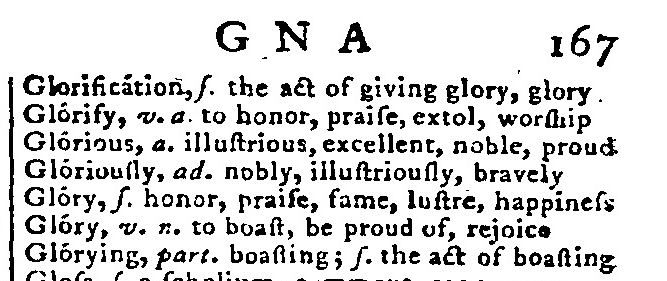
The difficulty is visible at the top of the scan. This is page 167, and the words are in the right column. Elsewhere in the same book, advanced and advantageous are six entries apart, again exactly as the letter predicts. But a page turn falls between them, where the letter puts both on page 7. Even changing how the pages are numbered would leave that discrepancy.6
The agents compared more than twenty surviving copies of Entick, including later printings to see which layouts printers reused. None put both G words where the writer needed them. A separate search through the machine-readable text of 81 dictionary scans also failed to turn up both pairs the right number of pages apart. Old print is easy for software to misread, so those searches tell us less than looking at the pages themselves.7
These checks ruled out several once-plausible printings. The similar word order keeps other printings of Entick worth checking, though other dictionaries could share that order too. The agents have yet to identify the book or read a new dispatch with it.
A copy still worth opening
The Huntington Library in California has a copy of Entick catalogued as about 1784. Its date falls between a 1783 printing that puts glorious on page 158 and the 1785 printing that puts it on 167. The date alone tells us little about the layout. A photograph of page 163 would settle whether this copy passes the first test.8
If glorious and glory land in the two expected places, there are independent checks near both ends of the alphabet. Page 7 should have advanced and advantageous in the same column. On page 422 the 14th entry on the right should be water. A book that passes all three tests would be worth trying against dozens more known words.
Explore the 1785 dictionary
Where else might the same series of entries turn up? Reception Reader compares wording across eighteenth-century books. AI agents used scans available through it to examine the printed columns. The map below offers a way to pursue the search into other books.9
Each dot marks a passage in Entick that a computer also found in another book. Dots farther down come from later pages in Entick. The dates along the bottom belong to the other books. Blue dots are close to 1785, and the greener dots are farther away in time. Try a dot to the left of 1792 to see the two passages side by side. If the other book is a dictionary, it was already in print when the Natchez letter was written. Its page 163 is worth a look.
Notes and sources
-
1
William R. Shepherd drew on Spanish records in “Wilkinson and the Beginnings of the Spanish Conspiracy” (1904). See also the National Park Service’s biography and James Sharples’s pastel portrait at Yale.
-
2
The researchers’ readings of the Natchez letter give its date, the code for pension and the sum due. The National Park Service traces the changes in who governed Natchez.
-
3
Christopher Chu, Raphael Valenti and Kevin Knight reproduce both versions in figure 2 of their 2020 study, from manuscript copies supplied by the Library of Congress. The images here are details of that figure.
-
4
Austin Travis Wheeler, The Scandalous General James Wilkinson (Texas Tech, 2009), pp. 16–20 and appendices A–C. Chu, Valenti and Knight, “Solving Historical Dictionary Codes with a Neural Language Model” (2020), table 2. Their manuscript inventory distinguishes letters with and without readings.
-
5
Jay’s letter of 1781 names the 1777 Entick and explains his own code. Wheeler, pp. 16–17, discusses the Entick suggestion, the separate Aaron Burr correspondence of 1806, and his reasons for considering Perry.
-
6
The two known G words; Perry’s Worcester printing, p. 163; Entick’s London printing, p. 7, p. 8 and p. 167. The type at the head of each entry is what the agents counted.
-
7
The first 22 copy checks link to the pages examined. The follow-up record documents six more Entick printings, checks of other dictionaries, and the 81-scan search. A word inside a definition can fool a text search that is looking for an entry.
-
8
The Huntington catalogue, rare book 480434, supplies an estimated year and no image. The 1783 comparison page can be read online. See also the open problem and its archives.
-
9
David Rosson and colleagues describe the comparisons and the chart in “Reception Reader: Exploring Text Reuse in Early Modern British Publications” (2023). A dot records shared wording. To identify a codebook we also need the printed page, column and position.