Heerlen, the Netherlands
What game wore down this stone?
A piece of limestone from the Roman town beneath Heerlen has a smooth patch beside one diagonal cut. In 2026, researchers proposed that players wore it down in a game where one side tried to trap the other.
Roman writers mention board games, but no surviving Roman text describes one in which a player wins this way. If the researchers are right, this stone preserves a way of playing that we might otherwise have missed.
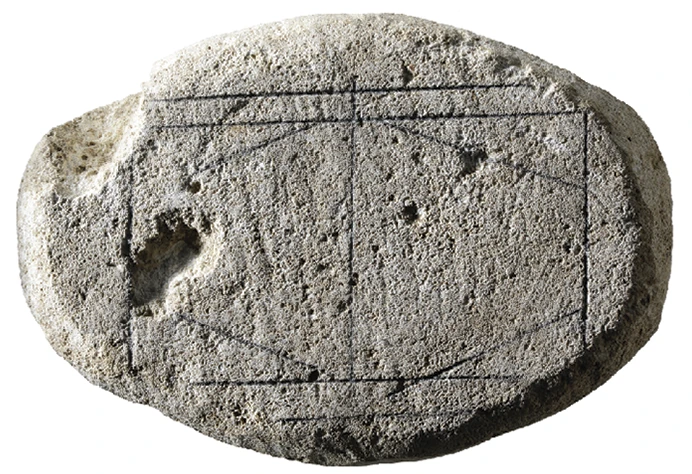
The dark lines are modern pencil marks following the ancient cuts.
How could they tell? Imagine two people using pebbles as playing pieces. If they slid a pebble along the same route for years, the limestone there might gradually feel smoother. The researchers had computers play different games on a copy of the board. Nine combinations of rules and board layouts matched the wear, and all nine involved trapping pieces.
We went back to the researchers’ move records. A different game also kept sending pieces around the worn corner. Its aim was to get three of your own pieces into a straight line, much as you would in tic-tac-toe. You can see the problem by making one move in each game.
Try the two movesTwo ways to play on the stone
How do you trap a hare?
You have four blue pieces, the “dogs.” Your opponent has two ivory pieces, the “hares.” The names come from a later game. We don’t know what Roman players called their pieces.
On each turn, one piece slides along a cut to the next empty spot. You win if neither hare has anywhere left to go.
The hares are together on the right. Move the blue dog at the bottom of the board to close their last way out.
Where did the pieces go in 1,000 games?
The two moves above are examples we set up. For evidence, we counted the moves in two sets of games the researchers actually ran. In one set, the computer players tried to make a row of three. In the other, three dogs tried to trap two hares. Each set contains 1,000 games.
Look at the little triangle in the lower right. It includes the worn diagonal and the two stretches of board beside it. In both games, roughly nine slides out of ten followed one of those three paths.
Trapping the hares
90.8% of all slides
Making a row of three
91.2% of all slides
We chose these two sets because their patterns look alike. Other starting positions gave different results. If repeated slides smoothed the stone, either game could account for the location of the worn patch. It would take another clue to tell us which game the people of Heerlen played.
Would people play like these computer players?
In this recorded game, Blue and Ivory are both trying to make a row of three. Start at turn 80 and watch four turns. Blue slides a piece out and back. Ivory does the same. Both have returned to exactly where they started.
The researchers set the computer a limit of 250 turns per game. All 1,000 games of three in a row on this layout reached that limit without a winner. Every trip back and forth counted as another slide. People might change tactics or give up much sooner, leaving a different pattern on the stone.
Why did the published study favor a trapping game?
The researchers first looked for games in which one diagonal got at least twice as much use as an average path. There are 15 paths here. A diagonal had to carry at least 13.33% of the slides to qualify. They then examined which other paths saw play. All nine of their final candidates were trapping games.
For three in a row, two files in their archive disagree about that first test. We can reproduce the higher figure by counting the individual moves. The authors also deposited percentages adjusted to account for players approaching the board from different sides. Those percentages give a lower figure.
Share of slides on the busiest diagonal
Even the middle line changes, from 0.09% to 1.11%. That line stays in the same place when you flip the board. We still don’t know which step, or which set of games, accounts for the difference.
What evidence would help?
A Roman account describing how to win on a board with these markings would give us an answer. In the meantime, there is an experiment we can do. Give people copies of the board and teach half of them each game. After a few evenings of play, could someone who missed the games tell the two groups apart from the paths their pieces took?
Read the study and inspect the move records
Walter Crist and colleagues studied object 04433 at Het Romeins Museum in Heerlen. Their photograph shows the stone before cleaning. The annotation locates the reported wear approximately. The playable surface follows their preferred layout, joining closely spaced cuts into single playing spots. The blue and ivory pieces and both teaching positions are illustrations. Study and figures, Antiquity (2026). Photograph courtesy of Restaura, cropped from figure 1A, CC BY 4.0.
All counts and the replay use board 6 in the authors’ public archive. We counted slides between neighboring spots, leaving out the initial placements. The three-dog example starts with the hares moving first. The local computer opponent lets you play the rules yourself. The archived players used Ludii. Replication archive, version 1.0 · Individual games (ZIP) · Move counts (ZIP) · Adjusted percentages (ZIP) · Supplementary methods.
Methodology
Could two different games wear down the same corner? We chose two sets of 1,000 games from the researchers’ move records because their paths looked alike. Both used the same layout of the stone. In one set the players tried to trap hares. In the other they tried to make a row of three. We counted each slide along a path, leaving out the moves that placed pieces on the board.
We then counted again for just the worn diagonal. Replaying one game showed how a piece could travel back and forth, adding to the count each time. The two sets show that different rules can produce similar tracks. They leave open how often people would repeat those moves.