What game was played on this Roman stone?
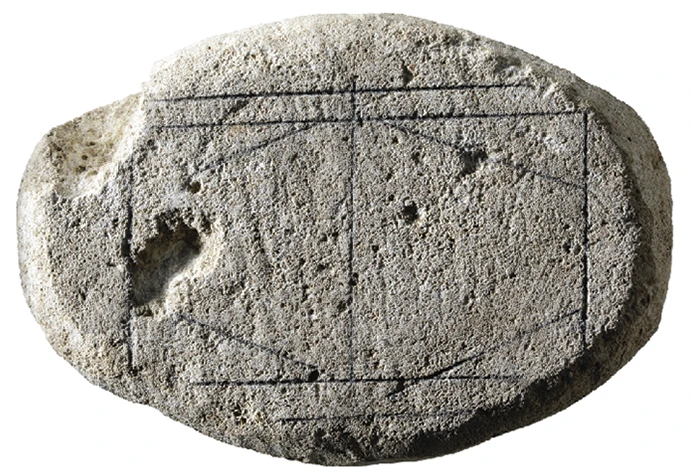
Someone in the Roman town of Coriovallum, now Heerlen, scratched a board into a piece of limestone and played on it long enough to wear one patch smooth.
No Roman writer describes this board, and nothing quite like it has been found anywhere else. The rules are lost.
Our best guess is a chase: three hounds trying to corner one hare. You can play it on the stone, and then see why we think so and how far the evidence really goes.
The only clue is a smooth patch
The pattern is simple: a rectangle, a line down the middle, and four slanting lines. In 2026 the archaeologist Walter Crist and six colleagues noticed something about the surface. Beside one of the slanting lines, the lower right one, the limestone is smoother than anywhere else on the stone. Their explanation was that playing pieces had been slid along that line again and again.
That gave them a way to test rules nobody wrote down. They had a computer play 130 different sets of rules on a copy of the board, a thousand games each, and counted which lines the pieces travelled. Nine sets of rules sent heavy traffic down one diagonal and little down the middle, as the wear suggests. All nine were games in which one side hunts the other.
If they are right, it matters in two ways. Hunting games like this are not recorded in Europe until the Middle Ages, so this stone would push them back by centuries. And a method that reads rules from wear could be tried on the many other ancient boards whose games are forgotten.
We went through their published data and then worked out every possible position on the board ourselves. We think they found the right kind of game but the wrong version of it, and that the smooth patch says less than it seems to.
Play the game we think it was
The red marks show which lines the pieces have used in this game.
Three sets of rules to try on the same board:
Three reasons to think it was a chase
The lines are roads, not rows
The Roman game we know best from small scratched boards is three in a row. The poet Ovid mentions it. On its usual square board every line passes through three points, because every line is a place where you can win.
This board is different. Five of its lines, shown in red, join only two points. Nobody can make a row of three on them. They only make sense as routes for pieces to travel, which is all a chase needs.
Every known relative is three against one
The versions the study picked mostly give one player four pieces and the other two. No recorded game uses those numbers.
The study itself lists the nearest relatives: country games written down in Denmark, Spain, France, Italy and Greece over the last two centuries. Almost all of them set three hunters against a single quarry. In the Spanish game and one of the Danish ones, the hunters may not move backward.
- Haretavl and Hund efter hare, DenmarkThree dogs, one hare
- La liebre perseguida, SpainThree dogs, one hare. The dogs may not go back.
- Jeu des gendarmes et du voleur, FranceThree policemen, one thief
- Gioco dell’orso, ItalyThree hunters, one bear
- To kinégi tou lagoú, GreeceA hunter and two dogs, one hare
It is the only version that is a real contest
The board has ten points. That is few enough for a computer to work through every possible position and say for certain who wins when nobody makes a mistake. We did that for four versions of the chase.
Three of them are lopsided. Only one leaves both players something to play for, and it is the one with the numbers and the no-retreat rule found in the real games.
- Four hounds, two haresThe hounds cannot lose. This is the study’s pick.
- Three hounds, one hare, free to move any wayThe hounds cannot lose, and win within ten moves.
- Three hounds, two haresThe hares can nearly always dodge for ever.
- Three hounds, one hare, no retreatThe hounds win only if they play exactly right. One slip and the hare is through. When both sides move at random, the hare escapes two games in three.
Why is only one diagonal worn?
The board is symmetrical. Any game should wear its four slanting lines about equally, yet only one is smooth. The study suggests a habit of the players, such as favouring the right hand.
There may be a plainer reason. That line was cut in the wrong place.
The slanting lines are meant to meet the middle line at the top and bottom of the board. None of them quite does. The study measured the gaps: 1.0, 0.9 and 0.6 cm for three of them, and 2.4 cm for the worn one.
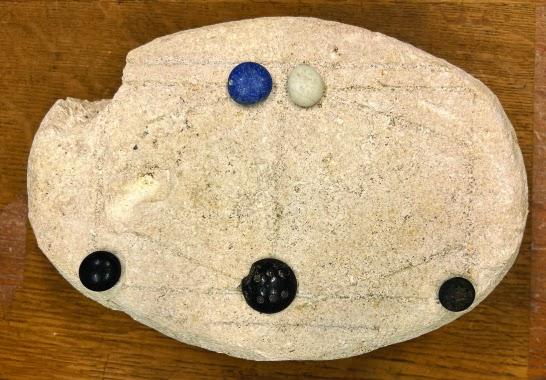
The glass counters found in Roman Heerlen are roughly 2 cm across. A counter resting on the middle point already touches the other three lines. To get onto the fourth, it has to be pushed across a strip of bare stone, every single time.
This is a hunch, and we have not been able to test it. The test is simple. If it is right, the smooth patch lies in that gap.
What the smooth patch cannot tell us
Here is the awkward part, and it is as awkward for our guess as for theirs. How much a line gets used depends more on who is playing than on which game they are playing.
The study’s computer player sent 15 per cent of its moves down one diagonal and almost none down the middle line. That is the pattern that matched the stone. Hand the very same game to a different kind of player and the pattern fades.
So the wear fits the idea that pieces moved along the diagonals. It does not pick out a game. Our case for hounds and hare rests on the shape of the board and on which rules make a game worth playing, and not on the wear.
Where that leaves it
If we had to bet, we would spread the money like this.
Three things would change those odds.
- Look at where the smooth patch sits. The museum has a 3D scan. If the wear lies in the gap between the middle point and the misplaced line, the wrong-cut idea holds.
- Find a second board. The likeliest places are museum stores along the roads out of Roman Heerlen: Cologne, Xanten, Nijmegen, Trier and Tongeren.
- Let people play. Give players copies of the board and glass counters for a few evenings, and see which rules they keep coming back to and where their pieces actually go.
Three things we found in the study’s data
The authors published their game records and code, which is the only reason any of this could be checked. Three points are worth knowing.
- For this layout of the board, 17 of the 21 sets of rules in the published game records are a single game repeated 1,000 times.
- The figures printed in the study cannot have come from those records. They appear to come from a later, more varied run that was not published.
- The script that screens the results asks for two columns that do not exist (
X173andX120), so one diagonal is skipped on two of the six board layouts.
None of this shows the study’s conclusion is wrong. It means the printed tables cannot yet be rebuilt from the public files.
Sources
Walter Crist, Éric Piette, Karen Jeneson, Dennis J. N. J. Soemers, Matthew Stephenson, Luk van Goor and Cameron Browne, “Ludus Coriovalli: using artificial intelligence-driven simulations to identify rules for an ancient board game,” Antiquity 100 (2026), doi:10.15184/aqy.2025.10264. Data and code: DataverseNL.
Photographs of the stone and counters are from the study and its supplement, licensed CC BY 4.0. The dark lines on the stone are modern, added to make the ancient cuts visible.
Methodology
For each game we listed every arrangement of pieces on the ten-point board, from 1,680 to 6,300 arrangements depending on the rules. We worked backward from the finished positions to see which side could force a win. Then we played thousands of computer games to see how the choice of move affected traffic on the worn diagonal. One player always took the quickest win or delayed a loss as long as possible. Another chose legal moves at random.
The comparison figure comes from the published study. With four hounds moving first against two hares, roughly 15 per cent of the slides followed one diagonal. The researchers flipped boards to line up the patterns before counting. We kept our boards in their original orientation, which limits how closely the percentages can be compared. The game records and code are public.