Heerlen, the Netherlands · Het Romeins Museum, no. 04433
What game was played on this Roman stone?
In the Roman museum of Heerlen sits an oval slab of pale limestone about the size of a paperback book. Nearly two thousand years ago, when the city was the Roman crossroads town of Coriovallum, someone carved a rectangle into its flat face, divided it down the middle, and cut four diagonals angling into the corners.
No surviving Roman text describes this board, and no identical example is known. In February 2026, archaeologist Walter Crist and colleagues proposed a clever way to narrow down the lost rules. Under a microscope, they found that the stone beside one of the four diagonals was rubbed smoother than the rest of the slab, as if glass or bone counters had slid across it for years. They fed the board into a game-playing computer program to test 130 candidate rulebooks. Every match was a “hunt” game—like later European Hare and Hounds, where one player tries to trap the other’s pieces—a kind of game never mentioned in surviving Roman writing.
Below, you can play four different games directly on a photograph of the stone—two hunt variants alongside Roman three-in-a-row and a small capture game—and see what the board’s own lines, dimensions, and wear marks can and cannot tell us.
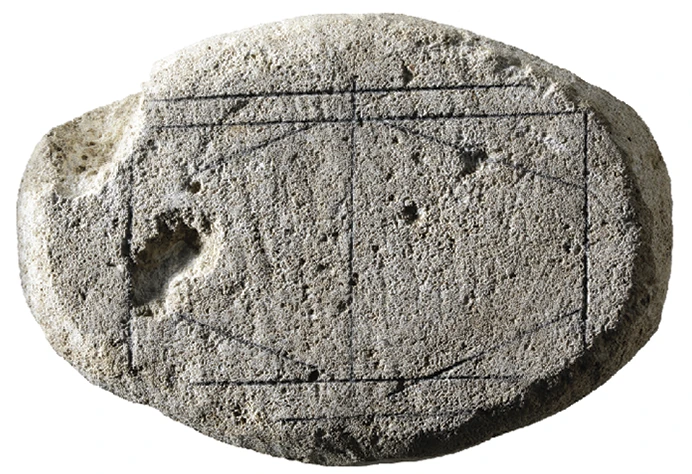
Dark lines are modern pencil marks following the ancient cuts (Restaura / Antiquity 2026, CC BY 4.0).
Play on the stone
Choose a rulebook below and click or drag counters along the carved lines. Red ink marks the paths your pieces use most, so you can see how each game feels—and where it sends traffic on the limestone.
Why three hounds against one hare fits the board
Look at the geometry of the carved lines. Five of the interior cuts—all four diagonals and the vertical center line—connect only two intersections. You can never make a row of three on a two-point line, nor can you sandwich an opposing piece between two of your own there. On standard Roman three-in-a-row boards (Terni Lapilli, mentioned by Ovid), every line holds three points. On the Heerlen stone, half the interior lines work best simply as roads for moving pieces—which suits a hunt or blocking game naturally.
Among hunt games, however, piece counts and movement rules matter enormously. Because this layout has only ten intersections, every possible position can be solved exactly. In the four-against-two version highlighted by the 2026 study, four free-moving hounds are too strong: from every starting arrangement on the board, they can force a trap in 15 or 16 moves, and no historical European hunt game uses four pieces against two.
Every comparable European hunt game—Danish Haretavl and Hund efter hare, Spanish La liebre perseguida, French Jeu Militaire—uses three hounds against one hare, and most forbid the hounds from moving backward. Played from one end of the Heerlen stone to the other under that rule, only about a third of board positions (570 of 1,680) are forced wins for the hounds. Against random moves, the hare escapes two-thirds of the time; with sharp play, the hounds corner it at the bottom end in 8 to 11 moves, sending roughly half of all traffic into the bottom corners while leaving the center line lightly used.
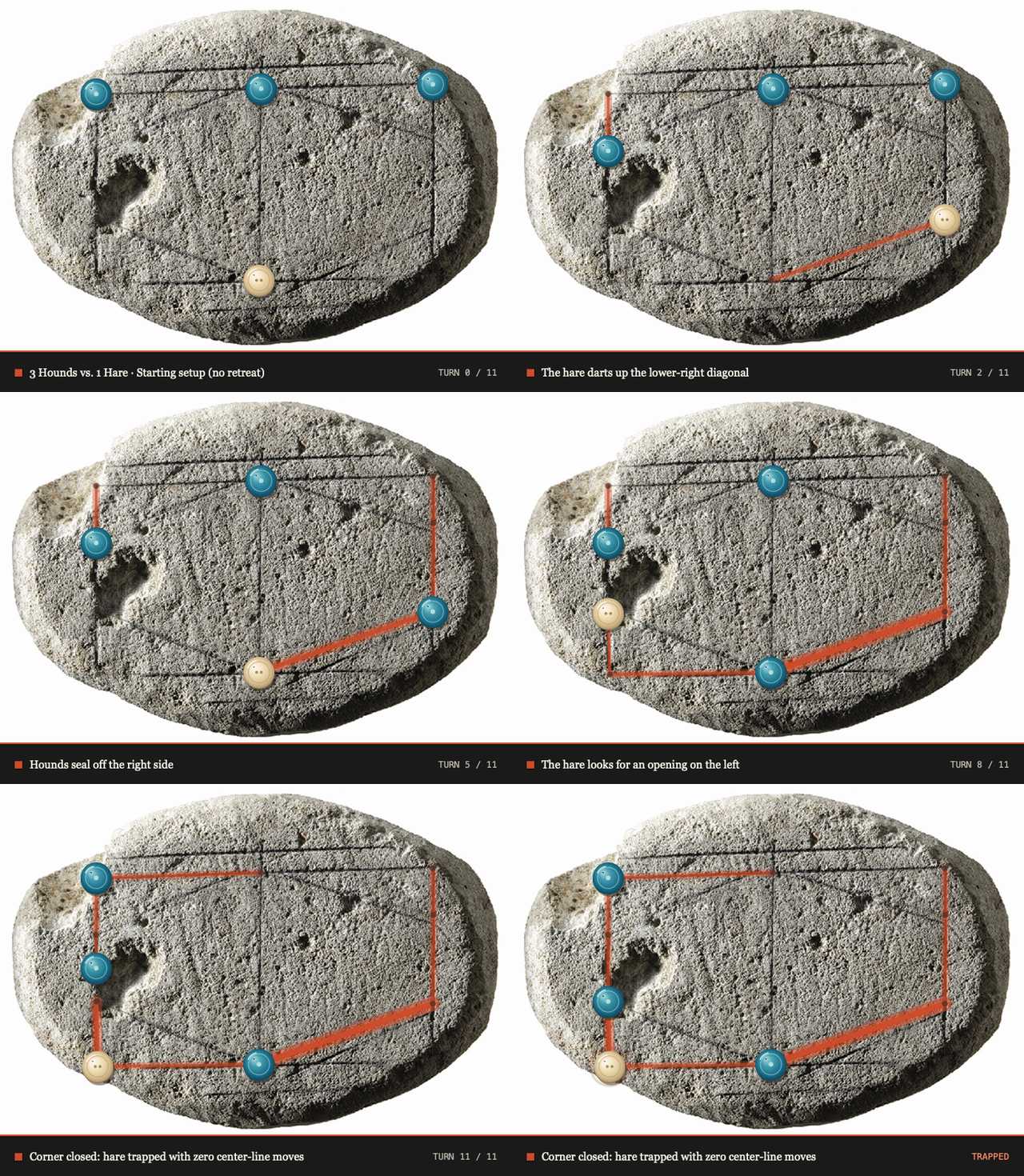
| Hunt variant on this board | Attested ratio? | Forced hound-win states | How it plays |
|---|---|---|---|
| 3 hounds vs. 1 hare, no retreat (top → bottom) | Yes (all European parallels) | 570 / 1,680 (33.9%) | Sharp hounds trap in 8–11 moves; hare escapes ~66–69% under random moves. |
| 4 hounds vs. 2 hares, free movement (2026 study) | No | 6,300 / 6,300 (100%)* | Forced hound win in 15–16 moves from the published starts; hares cannot win. |
| 3 hounds vs. 1 hare, free movement | Yes | 1,680 / 1,680 (100%) | Forced hound win in 9–10 moves from every position on the board. |
| 3 hounds vs. 2 hares, free movement | No | 388 / 5,040 (7.7%) | Hares evade indefinitely from the symmetric start; mostly draws. |
*Counts positions where blocked hounds pass, matching Ludii; counting dog immobilization as a loss gives 6,290 / 6,300. All counts are exact retrograde solutions of the 10-point board.
Why is only one diagonal worn smooth?
The board is symmetrical from left to right, yet only the lower-right diagonal shows a smooth patch beside it. Crist et al. suggested players might have had a subconscious habit—such as right-handedness—that favored one side whenever two moves looked equal.
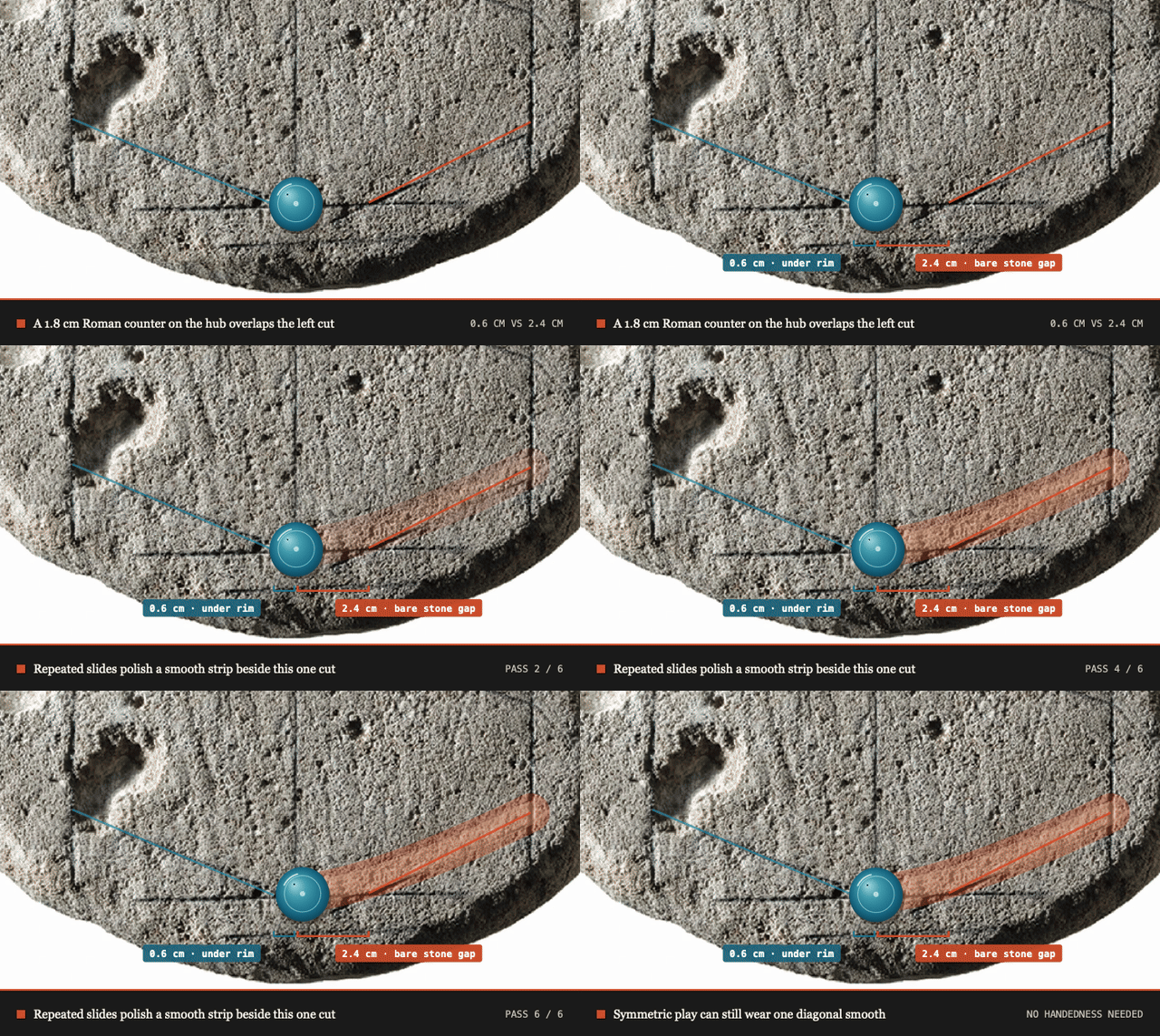
Their own measurements of the stone point to a simpler physical explanation. None of the four diagonals actually meets the vertical center line: moving clockwise from the top left, their feet stop short by 1.0 cm, 0.9 cm, 2.4 cm, and 0.6 cm. The 2.4 cm outlier is the worn lower-right diagonal.
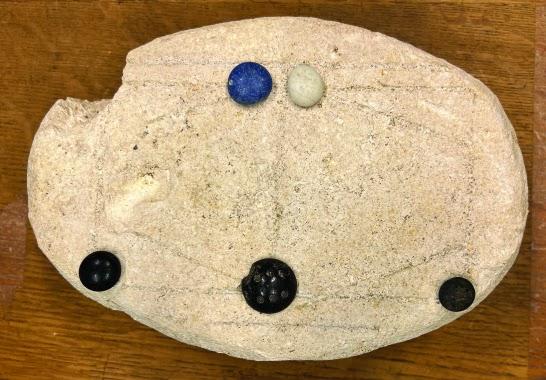
A typical Roman glass counter from Heerlen is roughly 1.8 cm wide. Sitting on the bottom hub, a counter that size already covers the foot of the bottom-left diagonal (0.6 cm away). To move onto the bottom-right diagonal, however, a player has to drag glass across a wide strip of bare limestone every time. Completely symmetrical play at the bottom end of the board could still polish a smooth zone beside that one cut, with no handedness bias needed.
What wear patterns can—and can’t—tell us
Even a good match between a computer simulation and a worn stone carries a catch: different computer players following the same rules leave very different trails. The 2026 study used an AI that judged positions by counting each side’s legal moves—a natural rule of thumb for a blocking game, but one that left its three-in-a-row players pacing back and forth until the 250-move limit.
When we ran the same four-against-two hunt game with other simulated players—exact optimal play, noisy play, or a neutral trial-and-error search program (Monte Carlo Tree Search) with no blocking heuristic—the sharp diagonal spike disappeared. Changing the simulated player on the same game shifted edge traffic nearly four times as much as switching the rules between a hunt game and three-in-a-row.
Wear counts alone cannot prove a single rulebook. Taking the two-point interior roads, European parallels, playability, and the 2.4 cm offset together, a three-against-one hunt game with no retreat is the strongest single candidate. Roman three-in-a-row (Terni Lapilli)—which Ovid actually describes—and a small capture game like Latrunculi remain plausible alternatives, and because the stone has no recorded findspot, the rules remain an open question.
What would settle it?
Check the bare-stone gap on the 3D scan
The 2.4 cm offset idea is directly testable on the museum’s 3D scan: does the heaviest microscopic smoothing sit across the bare limestone between the bottom hub and the foot of the lower-right diagonal?
Search Rhineland museum collections
Digital catalogs of modern games rarely hold informal Roman graffiti boards. A dated parallel is more likely to turn up in collections along Coriovallum’s road network—Cologne, Xanten, Nijmegen, Trier, Tongeren—or the Fribourg Locus Ludi corpus.
Test the board with real players
Simulated agents are not people. Giving human players replica boards and glass counters over several sessions would show both which rules feel natural on this geometry and what wear trails real hands leave behind.
Notes on the 2026 replication archive
Crist et al. deposited their simulation logs, edge-use tables, and R code openly at DataverseNL (v1.0). Checking all 134,000 individual game logs and 81 published supplementary table rows turned up two technical replication issues:
- A mismatch between the deposited logs and the published tables: In the deposited game logs (dated August 2023), 17 of 21 rulesets on Board 6—including all three published candidates—repeat one identical game 1,000 times. The symmetry-transformed files and Supplementary Tables S2–S7 (dated December 2023) clearly come from a later, more varied run whose individual game logs were not uploaded: the vertical center line, which stays fixed under every symmetry of the board, differs between the logs and transformed files on 73 of 118 matched setups, and 28 of 33 “untransformed” rows in Tables S2–S7 match neither archive.
-
Indexing bugs in the R screening script (
edge.R): On all six boards, the script drops the first ruleset column (HaretavlTAB) before filtering and omits edge 0 when calculating the mean threshold. Two column-name typos (X120on Board 3 andX173on Board 6) also skip one diagonal apiece, excluding Board 6’s 4-vs-2 Starting Position 2 (14.95% on edge 13, 0.00% center) from Table S7.
These archive quirks do not rule out a hunt game; they simply mean the published tables cannot currently be reproduced directly from the deposited trial files.
Sources and credits
Study: Walter Crist, Éric Piette, Karen Jeneson, Dennis J. N. J. Soemers, Matthew Stephenson, Luk van Goor & Cameron Browne, “Ludus Coriovalli: using artificial intelligence-driven simulations to identify rules for an ancient board game,” Antiquity 100 (2026), doi:10.15184/aqy.2025.10264 · Supplementary methods & figures (DOCX).
Archive: DataverseNL v1.0 · Individual trials (ZIP) · Raw edge counts (ZIP) · Transformed percentages (ZIP) · R processing script.
Photographs: Object 04433 (Het Romeins Museum, Heerlen) courtesy of Restaura, cropped from Crist et al. Fig. 1A; Roman glass counters on Object 04433 from Crist et al. Supplementary Fig. S16. Both licensed under CC BY 4.0.
Methodology
We used the ten playing points in the published drawing of the board to test several versions of hare and hounds. For each version we worked backward from positions where the hare was trapped. This tells us which starting positions guarantee the hounds a win. Changing the number of hounds or allowing them to move backward changes the answer.
We checked how often pieces crossed each line in the archived computer games and compared the counts with the study’s tables. We also compared the measured gap beside the worn line with the width of a Roman counter. Whether people actually slid counters across that gap remains a question for the museum’s scan.